

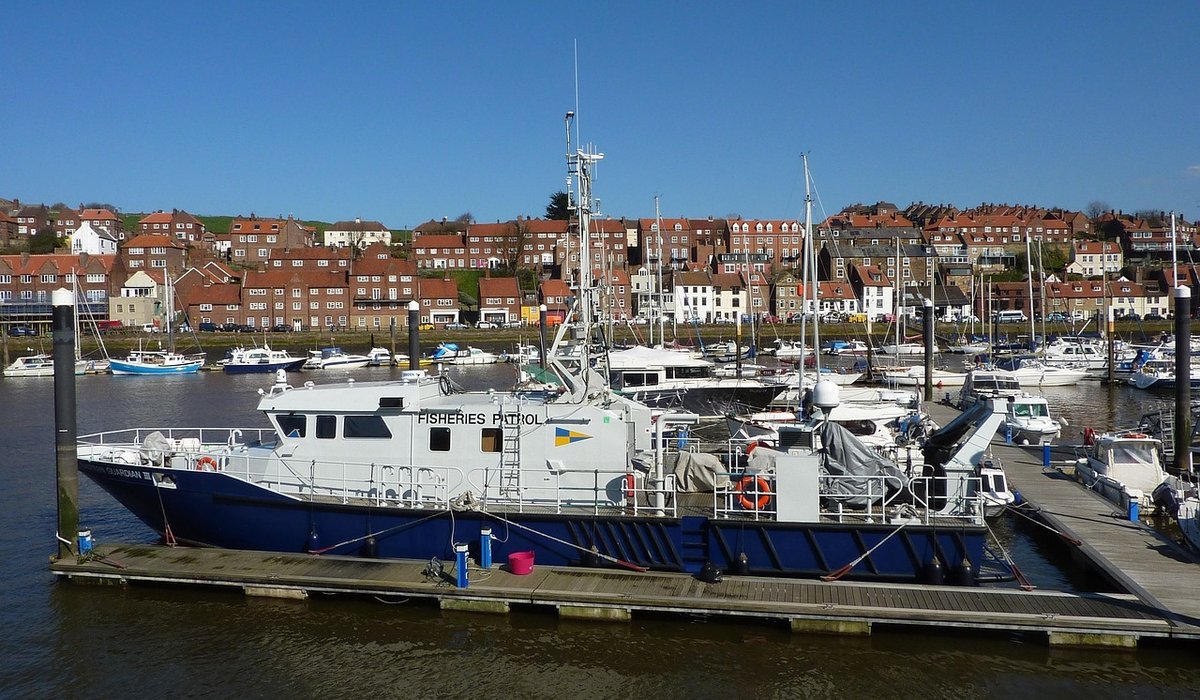
Why Whitby rewards a little tidal homework
Whitby is one of the most satisfying landfalls on the North Yorkshire coast. The Abbey on the cliff, the two piers, the smell of kippers — it is a place that repays a slow, well-timed arrival. But the approaches are not a place to treat the tide as an afterthought. The River Esk empties into the North Sea between two narrow piers, and the coastal stream runs across the entrance in a way that can turn a gentle sail into a scramble. Understanding the tidal streams here is less about earning a badge and more about keeping your passage calm and safe.
How the coastal stream sets along this stretch
Off Whitby, the flood stream generally sets southward down the coast, while the ebb sets northward. In ordinary spring conditions, expect rates of around 1 to 2 knots in the open approaches, but the stream is never perfectly parallel to the shore. It accelerates off headlands such as Saltwick Nab to the south and the higher ground towards Sandsend and Upgang to the north. It also bends around the harbour walls, and that bend is where the trouble starts.
Slack water is not a long, lazy pause. It can be brief — sometimes only 20 to 30 minutes of genuinely weak flow — and the turn offshore often happens before the turn inside the piers. A tidal stream atlas and a large-scale chart will show the set and rate, but the harbour entrance has its own local quirks that no table can capture.
- Flood: sets southward, stronger off headlands and over shallow ground.
- Ebb: sets northward, reinforced by the River Esk pushing out of the harbour.
- Slack: short, and not always where you expect it.
The entrance: a funnel with a river behind it
Whitby’s harbour entrance is a funnel. The River Esk is always trying to leave, and when there has been rain on the moors, it leaves with real purpose. On a strong ebb, the outflow between the West Pier and East Pier can reach 3 knots or more, and it does not simply push straight out to sea. It curls, eddies and sets across the entrance. You can be sailing comfortably towards the pier heads and suddenly find yourself being pushed sideways towards one of the pier ends.
In calm weather, the effect is manageable; aim up-tide and let the stream carry you into the fairway. In an easterly swell, or with wind against tide, the same stream can produce steep, confused seas right across the entrance. If the ebb is running hard and the wind is blowing from the east or north-east, stand off and wait. No schedule is worth a pounding.
Timing your passage through the approach
The simplest rule is to aim for the last of the flood or high water slack. At that point, the coastal stream is usually at its weakest, and the river’s ebb has not yet gathered full strength. If you are coming from the north, the flood gives you a fair ride down the coast; if you are coming from the south, the ebb is your friend. Either way, try to be at the entrance when the water is not moving hard in any direction.
Do not treat the tide table as gospel for the exact minute of slack. Add 15 to 20 minutes for the stream to turn offshore, and be prepared for it to turn earlier or later inside the piers. If you are under sail, reef early and keep the engine ready. A strong ebb can knock a knot or more off your speed over the ground, so allow extra time for the final approach.
- Plan A: arrive at high water slack, when the entrance is usually calmest.
- Plan B: if you must arrive on the ebb, approach from the south and aim up-tide of the pier heads.
- Plan C: if the ebb is strong and the wind is easterly, wait in Runswick Bay to the north or Filey Bay to the south.
Reading the water and a few hard-won habits
Before you commit, spend a few minutes watching the water. A line of disturbed, choppy water stretching seaward from the piers is the ebb. Smooth patches and swirling eddies near the pier heads show the stream bending. Gulls often sit in the weaker water, and their patterns can tell you where the current is strongest. If you see breaking water across the entrance in an otherwise moderate sea, that is the bar making itself known.
Use the pier head lights and the Abbey on the cliff as your principal landmarks. The Abbey is a wonderful back bearing, and the pier heads give you a clear transit into the fairway. Keep your eyes moving: from chart, to transits, to water, and back again.
- Listen to the water: if the entrance looks ugly, it probably is.
- Keep the engine ready: a reliable motor is useful when the stream turns against you.
- Brief your crew: everyone should know the plan, the hazards and what to do if you abort.
- Respect the ebb: it is the strongest and most unpredictable stream in the approach.
- Enjoy it: a well-timed arrival at Whitby, with the Abbey catching the light, is one of the great pleasures of this coast.


Coding is used in almost all aspects of life and work now, be it directly or indirectly. It’s not just for companies in the tech sector. “An increasing number of businesses rely on computer code,
Coding is used in almost all aspects of life and work now, be it directly or indirectly. It’s not just for companies in the tech sector. “An increasing number of businesses rely on computer code,
Coding is used in almost all aspects of life and work now, be it directly or indirectly. It’s not just for companies in the tech sector. “An increasing number of businesses rely on computer code,